
| |
The Program
The Northwestern Philosophy Department offers courses in a number of fields. At the higher levels graduate course offerings reflect the department’s particular strengths in Metaphysics and Epistemology (especially Epistemology, Philosophy of Language, and Philosophy of Mind), Ancient Philosophy, Continental Philosophy (Critical Theory including Critical Race Theory, and contemporary French Philosophy), Value Theory (Ethics, Aesthetics, and Political Philosophy), and Modern Philosophy (Spinoza, Descartes, and Kant). The Philosophy Department does not have a terminal master's program but a student may receive the MA degree after two years of satisfactory work in the PhD program. The doctoral program, designed to be completed in five years, includes three components: core courses, a background competence requirement, and dissertation. The core course requirements include two proseminars that emphasize supervised writing and research, courses in the history of philosophy, and minimal literacy in logic. The background competence requirement (which replaces our previous language requirement) requires one of the following (to be decided in consultation with the Director of Graduate Studies): (i) Competence in a second language other than English; (ii) Completion of a course in advanced logic (200 level or above); or (iii) Work in a related discipline (Linguistics, Cognitive Science, Mathematics, etc) or a complimentary philosophical area. The dissertation involves two oral examinations: one qualifies the student for dissertation research and the other for the final defense (or doctoral examination). Details of these requirements are available on request from the department.
Financial Assistance
Every student who is admitted into the program is guaranteed full tuition remission and five years of full funding, of which two are fellowship years. (The Fellowship years are typically the student’s first and fifth years in the program.) In addition, the department has an excellent record of success in securing teaching appointments within the University to support its sixth-year students, through TAships as well as teaching assignments in Northwestern’s School of Continuing Studies.
The Northwestern program is designed to give students teaching experience in a manner that is consistent with steady progress towards the PhD. We care about the quality of the teaching among our graduate student teachers and are proud of the recognition their teaching has received within the University.
After the first year, all graduate students are given faculty-supervised teaching experience. By assisting faculty members with undergraduate lecture courses and designing and teaching their own introductory undergraduate seminar, graduate students can develop a repertoire of courses they will be prepared to teach after completing their studies.
Speakers
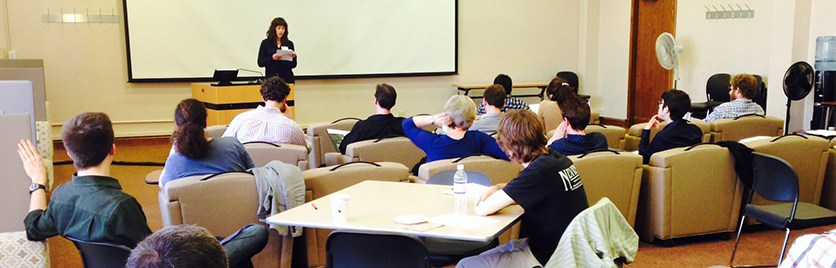
The Philosophy Department at Northwestern is a very active place.
We sponsor a wide variety of events that bring philosophy faculty from outside Northwestern to the department. Our Speakers Series typically brings in between eight and twelve speakers per year (including some proposed by the department’s graduate student organization), to present recent work to our department. In addition, we sponsor a variety of philosophical symposia and conferences. In the past few years events have included an annual Ethics Conference, an annual conference on Ancient Philosophy, the Midwest Epistemology workshop (an annual event in the Midwest that takes place at regular intervals here at Northwestern), an annual conference on German Philosophy (as part of the Chicago Area Consortium in German Philosophy), and several special conferences (one on “Violence, Sacred and Profane”; another on “The Epistemology of Disagreement,” co-sponsored by the journal Episteme). In addition, the Philosophy Department has been very involved in the Cognitive Science Speakers’ Series and, along with other departments, Philosophy has co-sponsored speakers in Political Theory, Religion, Classics, and German (among others).
There are other regular activities as well. Our PhLing group – a workgroup for work at the intersection of Linguistics and Philosophy of Language, composed of faculty and graduate students from Philosophy, Linguistics, and Psychology – meets quarterly to discuss new work by its members. And there are various regular book groups and discussion groups, including the Metaphysics and Epistemology reading group (which meets weekly throughout the calendar year), and the Social and Political reading group.
Finally, the Chicagoland area itself has a wide variety of philosophical activities in which faculty and graduate students from the Northwestern Philosophy Department participate. These include the Chicago Area Consortium in Ancient Greek and Roman Philosophy, the Chicago Area Consortium in German Philosophy, and the Northwestern/University of Chicago Syn/Sem group (linguists and philosophers interested in matters of syntax and semantics).
Placement
Members of the faculty make a concerted effort to place new graduates as well as students nearing completion of their doctoral degree who seek positions as college or university teachers and researchers. In recent years, these efforts have met with remarkable success; the department has a strong placement record that compares favorably to the records of other major graduate programs in philosophy.
Northwestern reserves the right to change without notice any statement on this page concerning, but not limited to, rules, policies, tuition, fees, curricula, and courses.
|